
Wire 2 Wire Vet Products
Client: Wire2Wire Vet Products
Innovative health solutions for horses, dogs, cats, and livestock. We rebuilt their eCommerce store, integrated social media, and delivered a complete marketing plan.
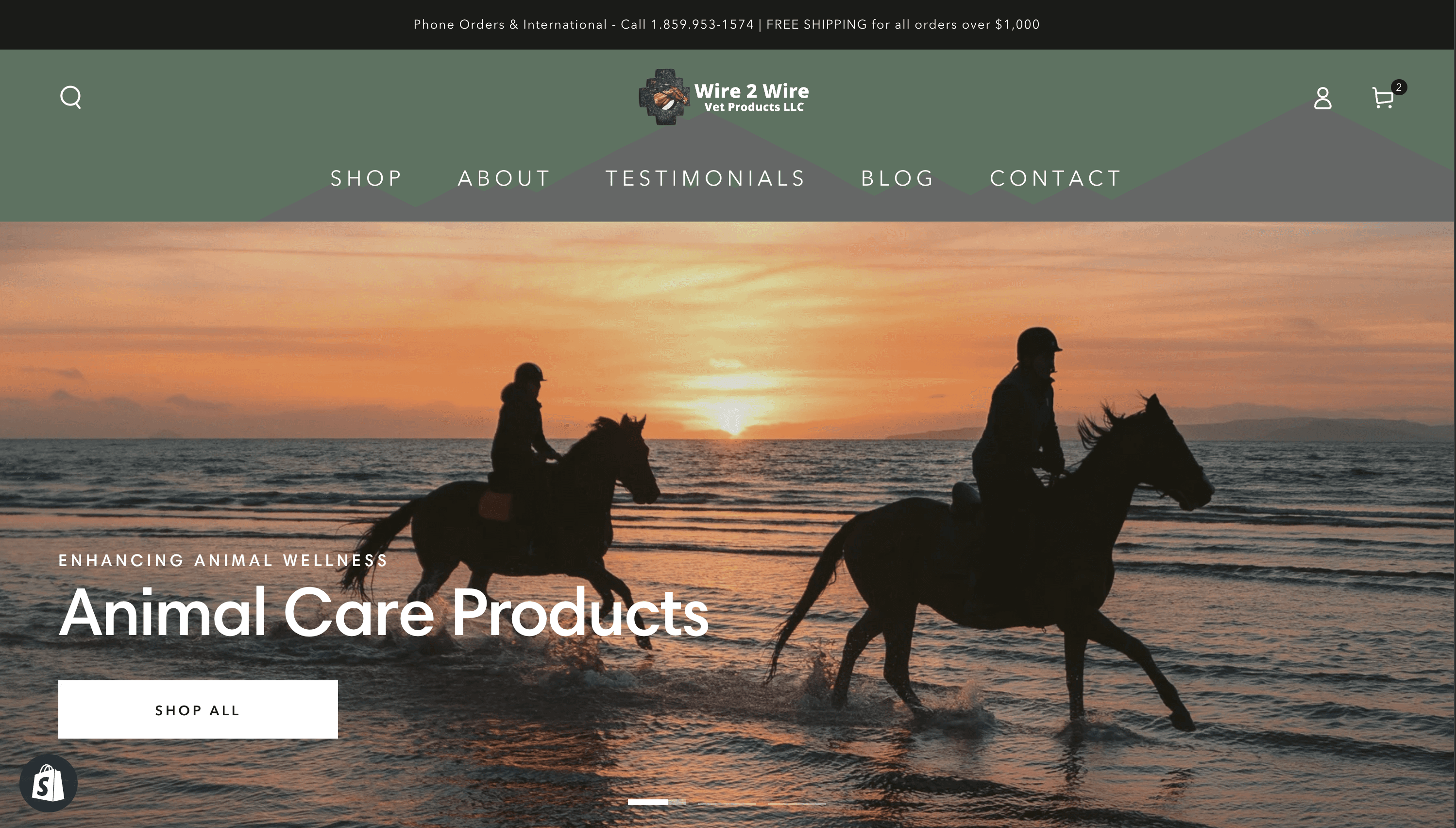
Wire2Wire Vet Products sells animal health products across three brands. They came to us running three separate online stores with no advertising and no email, and asked for one store they could actually manage. We consolidated the storefronts, then built the advertising, email and marketplace operation around them.
At a glance
- 3.4x store revenue once advertising went live
- +114% combined revenue, store and marketplace, year over year
- +168% direct store revenue, year over year
- +357% organic search clicks, year over year
The problem
The business was running three separate Ecwid storefronts — SilvaPlex, Flexineb and Wire2Wire — each with its own catalog, customers and admin. Every product change, promotion and order had to be handled three times.
- The 'back room' — storefront, selling and delivery modules — ran as disconnected systems rather than one operation.
- There was no marketing plan. Social accounts, search and marketplace existed as separate efforts with no strategy connecting them, and no advertising ran on any channel for the store's first eight months of trading.
- Paid acquisition, once live, had no clear per-product attribution; Google spend was almost entirely blended Performance Max, so nobody could say which products carried the cost.
- Two product lines had no dedicated campaign coverage on any channel.
- There was no automated email — no welcome sequence, no winback, nothing running between one manual campaign and the next.
- Product copy across the merged range had been written at different times to different standards, in a category where claims language is tightly constrained.
What we built
Store and migration
- One Shopify store replacing three Ecwid storefronts — SilvaPlex, Flexineb and Wire2Wire — built from October 2023 and launched 5 January 2024, with the legacy platform wound down the following month
- Catalog and customer migration: product data export and reformatting, import, variant consolidation across the merged range, and per-brand collections
- Domain consolidation and forwarding for the retired storefronts, plus DNS, business verification and transactional email setup
- Store admin training for the client team post-launch
Brand and packaging
- A product label and packaging system across the full range, begun alongside the store build in November 2023 and extended with the catalog since — including the No Rinse Shampoo label, from initial drafts through revisions, QR code integration, barcodes and the marketplace listing artwork
- Supporting print and packaging assets: GS1 UPC codes, a tri-fold brochure, and New Zealand and European import label variants
Advertising
- A written marketing plan covering Facebook, Instagram and Google, delivered February 2024 and reviewed with the founders
- Google Ads account built from scratch: conversion tracking, Search Console and Analytics linkage, then Performance Max and Search campaigns
- Meta Ads account with campaigns segmented by product line
- A per-product ad scaling framework: campaign-level ROAS thresholds with defined monthly budget increments and pullbacks against an agreed account ceiling, replacing ad-hoc month-to-month budget decisions
Amazon marketplace
- Amazon Ads account: Sponsored Products and Sponsored Display across the pet and equine lines
- Amazon listing operations: A+ content, product listings, FBA shipment labels and ASIN stickers
Email and retention
- A seven-email automated welcome series, live, built on a segmentation question captured at signup
- A two-email customer winback flow, live
- A recurring promotional email calendar spanning Black Friday, Cyber Monday, St. Patrick's, 4th of July and America 250
- Subscribe and save on the store's consumable lines, launched August 2026
- An affiliate program, live
Store content and copy standards
- Cross-sell and upsell linking across compatible products
- On-site review carousel and customer testimonials
- Blog program with published posts and supporting graphics
- Black Friday product bundles and collection layouts
- Rewritten SEO titles and meta descriptions across the store
- A single claims standard for the catalog, with a page-by-page copy review and reusable templates for new products
Social and reporting
- Social account consolidation: Facebook page recovery and verification, Instagram account setup, Facebook and Instagram Shop configuration
- Influencer seeding, TikTok account setup and a social content pipeline
- Attribution reporting and monthly written performance reports
Built with: Shopify, Ecwid (legacy, migrated from), Klaviyo, Google Ads, Meta Ads, Amazon Ads, Amazon Seller Central / Brand Registry, Triple Whale, Judge.me, Google Analytics, Google Search Console

The No Rinse Shampoo label. A paw mark and species illustration answer who the product is for at a glance, so the required text underneath doesn't have to.
What made it hard
Three catalogs that had drifted apart
Three storefronts meant three catalogs that had drifted apart — overlapping products, inconsistent variants, and customer records split across separate systems. A straight import would have carried the mess into the new store.
We exported and reformatted the product data before importing rather than after, then ran a dedicated variant-consolidation pass across the merged catalog, and rebuilt each brand as a collection inside the single store so the individual product lines kept their identity without needing their own storefront. The retired domains were forwarded rather than dropped, preserving inbound links and existing customer bookmarks.
Fitting a regulated label onto a small bottle
The labels had to carry a long list of required content — ingredients, directions, claims, regulatory text, barcodes — onto small bottles, across a range sold to buyers as different as show breeders and ordinary pet owners. The default outcome is a crowded label that shrinks type until everything technically fits and nothing reads.
We designed to a hierarchy instead of to the margins. A simple hoof-and-paw mark carries the species question at a glance, so the label doesn't have to spell out who the product is for; the key benefits sit in a fixed position and order across the range; and required text is placed rather than squeezed. The result reads as a consumer product on a shelf next to national brands, while still carrying everything the category demands — and the system extends cleanly to new products and to international variants.
Optimizing for ROAS quietly narrowed the catalog
Optimizing every campaign for return on ad spend quietly narrowed the catalog being advertised. Budget consolidated into the two proven winners and the lower-margin consumables were switched off — one line was running at barely break-even after fees — which protected efficiency but stalled awareness for everything else.
We put the trade-off to the client directly rather than deciding it unilaterally, and agreed to subsidize growth on the developing lines out of the established winners' returns. That was paired with a per-product scaling rule — grow a campaign's budget by a set increment while it clears the ROAS threshold, pull it back when it doesn't, against an agreed account ceiling — so the decision was systematic and reviewable in a monthly report instead of relitigated every month.
The Meta pixel stopped reporting purchases
The Meta pixel stopped firing purchase events, so the platform reported zero purchases against a full month of spend. The entire Meta budget was unaccountable and at risk of being cut on bad data.
Rather than judge the channel on the broken signal, we cross-referenced third-party web attribution against Shopify orders for the same window. That recovered the real purchase volume and showed the campaign pivot was working — the channel was performing well above breakeven, not failing. Budget decisions were made on the recovered figures while the pixel was diagnosed.
The client challenged our own unit economics
The client challenged our own unit economics. Blended returns looked healthy; one lower-priced line on its own did not, and the client said so directly.
We segmented rather than defended. Filtering the order data by legacy customers and by outlier repeat buyers confirmed the client's read: the high-value equipment line was subsidizing acquisition for the lower-priced consumables. The same analysis established that almost none of the new store's orders came from migrated customers, confirming the growth was genuine new-customer acquisition.
One catalog, four completely different buyers
One catalog, but wildly different buyers — show breeders, hobby horse owners, cattle and sheep producers, and ordinary pet owners — with products ranging from an inexpensive consumable to a piece of veterinary equipment two orders of magnitude more expensive. A single email flow would have missed most of them.
We moved the segmentation decision to the point of signup, capturing which animals a subscriber cares for as a profile attribute before the discount code is delivered, then branching on that answer and using dynamic blocks so one sequence could serve several audiences without building ten.
Writing copy in a claims-sensitive category
Animal health is a category where what you may say about a product is tightly constrained, and a catalog merged from three storefronts carried copy written at different times to different standards. Reviewing it product by product, ad hoc, was never going to hold as the range grew.
We set a single claims standard for the catalog and reviewed the range against it, then turned the result into reusable copy templates — so new products start from language that already meets the standard rather than being corrected afterwards.

One catalog, very different buyers — the equine line sits alongside pet products that reach an entirely separate audience.
Results
- Three storefronts became one, built and launched in about ten weeks. — three separate Ecwid storefronts → a single Shopify store — 25 October 2023 – 5 January 2024
- Turning on advertising more than tripled the store's average monthly revenue. It had traded for its first eight months with no paid acquisition at all. — 3.4x the pre-advertising average — first twelve months of advertising vs the eight months prior
- Total revenue across the direct store and the marketplace channel more than doubled year over year. — +114% (trailing twelve months to August 2026 vs prior twelve) — Sep 2024 – Aug 2026
- The direct store grew far faster than the marketplace, shifting the business toward its higher-margin sales route. Marketplace revenue fell from roughly two-fifths of the total to roughly a quarter — not because it shrank, but because direct sales outran it. — marketplace 42% of combined revenue (Sep 2024 – Aug 2025) → marketplace 27% of combined revenue (Sep 2025 – Aug 2026), having grown 39%; direct store grew 168% over the same period — trailing twelve months vs prior twelve
- Traffic grew, and each visit became worth more — the store converts better, it doesn't just attract more people. — 17,885 sessions Jan–Aug 2025 → 31,573 sessions Jan–Aug 2026, with revenue per session up 41%
- A single promotional campaign produced the store's best month on record, and the client called it their strongest response to any promotion they had run. — 2.7x July 2025, and the highest month since launch — July 2026
- Sales of the flagship equipment line — the highest-margin product — went from occasional to near-daily, which the client attributed to the advertising work. — roughly one per month → approaching one per day — as of July 2026 (reported by the client)
- The promotion pulled buyers away from an established competitor, several of whom bought additional products on the same visit. — July 2026 (reported by the client)
- The client reports customers returning to buy again and recommending the products to others, including repeat and case-volume orders through the store. — as of July 2026 (reported by the client)
- Google Ads recovered from a weak February to return several times its cost through spring and early summer 2026. — 6.1x–7.5x, up from 1.8x (February 2026) — March–June 2026
- Organic search visibility grew sharply year over year, from a standing start after the consolidation. — +357% clicks, +570% impressions — twelve months to 2026-08-20
From rebuilding our website to tying together the web page and selling/delivery modules that make up the 'back room', to integrating the social media platforms, you have moved us into the modern world in short order. When we started working with you and your team, I did not anticipate that you would present us with such a clear and well laid out marketing plan that includes detailed steps needed to effectively get the most out of tools such as Facebook, Instagram and Google. Your outline, without being asked, took the entire project to another level. The fact that I didn't have to ask for this next step makes all the difference. Nice that you were able to address questions I didn't know existed. Great job.
— Richard Hoffberger, Co-Founder, Wire2Wire Vet Products
Project Gallery


